Dropshipping Video Ad Creative Testing
Dropshipping video ad creative testing means running several short ads for the same product, each with a different angle or hook, and keeping only the ones that earn attention and clicks. One video rarely tells you whether the product is good; it mostly tells you whether that first angle was good, so you need a small batch to learn anything.
Use the dropshipping video ad generator to turn one product photo into several short ad variations, so testing does not depend on ordering samples or booking creators.
What should you test in a dropshipping video ad?
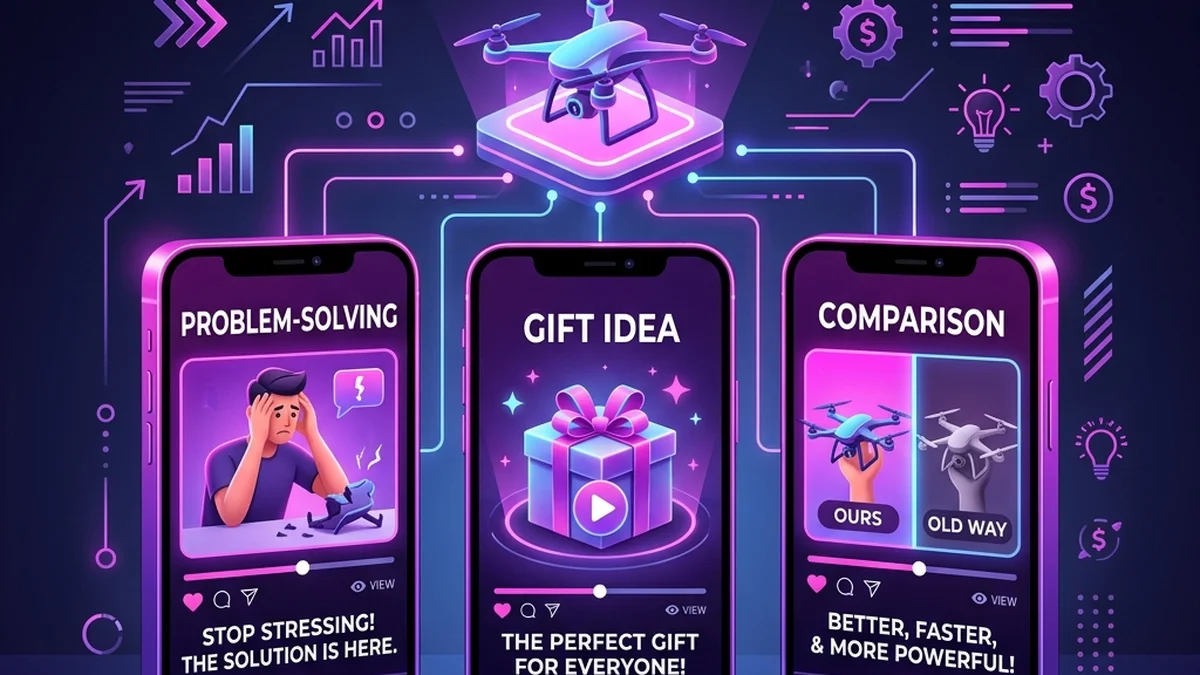
Test angles first, then hooks, then format. The angle is the reason to buy, such as solving a problem, making a good gift, or looking better than a cheaper version. The hook is the first line that delivers that angle. Format, length, and CTA matter too, but they rarely rescue an angle nobody cares about.
Create different versions for:
- Problem/solution.
- Curiosity.
- Gift idea.
- Product demo.
- Review-style social proof, using real reviews only.
- Before/after explanation.
Niche pages like the tech product video ad scripts and fitness product video ad scripts have starting wording for two of the biggest dropshipping categories.
How many video variations should you test per product?
Five is a practical starting batch for most stores: enough to cover distinct angles, small enough to compare without a large budget. Three works for a quick sanity check on a product you are unsure about, while seven or ten makes sense once you know the product sells and want to find a stronger hook.
TalkPix renders batches of 3, 5, 7, or 10 ad creatives per product from the same photo, each with a different angle and script. Because each ad is billed by its real length at 1 credit per second at 720p, a batch of five 10-second ads uses about 50 credits, which is the $5 pack. The exact cost is shown before anything renders; see pricing.
What does a simple test plan look like?
A simple test plan gives each video one job and one metric. Keep the product photo, offer, landing page, and audience the same, change only the script angle, and give each ad a comparable share of spend. Then judge early on attention signals and later on clicks and add-to-cart, not on a single day of results.
| Video | Angle | Example first line | Watch for |
|---|---|---|---|
| 1 | Problem hook | "If your phone dies by 3pm, look at this." | Hook retention |
| 2 | Benefit hook | "This fits in a pocket and charges twice." | Click-through |
| 3 | Gift hook | "An easy gift for the person who travels a lot." | Saves and shares |
| 4 | Review-style | Read one real customer review, word for word | Comments and clicks |
| 5 | Explainer | "Here is what it does and who it is for." | Add-to-cart from page |
The script template library has wording for each of those five, and the UGC video ad scripts page adds more creator-style openers.
How long should a dropshipping test video be?
Keep first test videos short, roughly 6 to 15 seconds. Short videos are cheaper to render, faster to watch through, and easier to compare, because the hook carries most of the result. Once an angle proves itself, make a longer version that answers objections for retargeting or for the product page.
Short also suits the format: a TalkPix product ad script is capped at 300 characters, which keeps each variation tight. For aspect ratios and per-platform limits, see the video ad specs for ecommerce.
What should you do when no angle works?
If none of the variations earn attention, the problem is usually the product, the photo, or the buyer problem rather than the editing. Check whether the product is visually clear, whether the problem is something people actually feel, and whether the price makes sense next to similar listings. Fix those first, then make new videos.
If one angle gets attention, generate more versions around it. If none work, the product may be weak, the photo may be unclear, or the buyer problem may not be obvious enough. Sometimes a real person filming the product in their hand is the right next step, and that is a fair conclusion from a test.
How do you keep dropshipping ads honest?
Keep scripts tied to real product details and avoid claims you cannot prove. Dropshipping ads often drift into exaggerated health, income, or performance promises, which can get ads rejected and lead to refunds and chargebacks. Only use images you have permission to use, and only quote reviews that real customers wrote.
TalkPix's batch mode deliberately leaves out the real-customer-review angle, because that angle needs a review you paste in and confirm; the single-ad flow reads your pasted review word for word. The AI presenter is a creator-style pitch, not a customer, so do not caption it as one.
Which examples help plan the first batch?
The dropshipping example pages show product validation, hook testing, and retargeting angles with scripts you can adapt, which is faster than starting from a blank page. Compare a few before writing your own batch, then copy the structure rather than the exact wording.
Use the dropshipping video ad examples to plan the first batch. Helpful next pages:
- TikTok Shop fitness product ad example
- Tech gadget video ad example
- AI product video generator
- Best UGC video ad generators
Generate dropshipping ad variations
Upload one product photo — get a UGC-style talking video ad, no filming needed.
Create dropshipping videoWhat is the simplest way to start?
Pick one product, one clean photo, and five angles. Render the batch, run the ads with comparable spend, track which hook earns clicks or saves, and put more production money only behind the ones that win. Repeat the cycle on the winning angle before moving to a new product.